
From Ivory Chips to Blockchain Bets: Tracing Currency Shifts in Gambling History
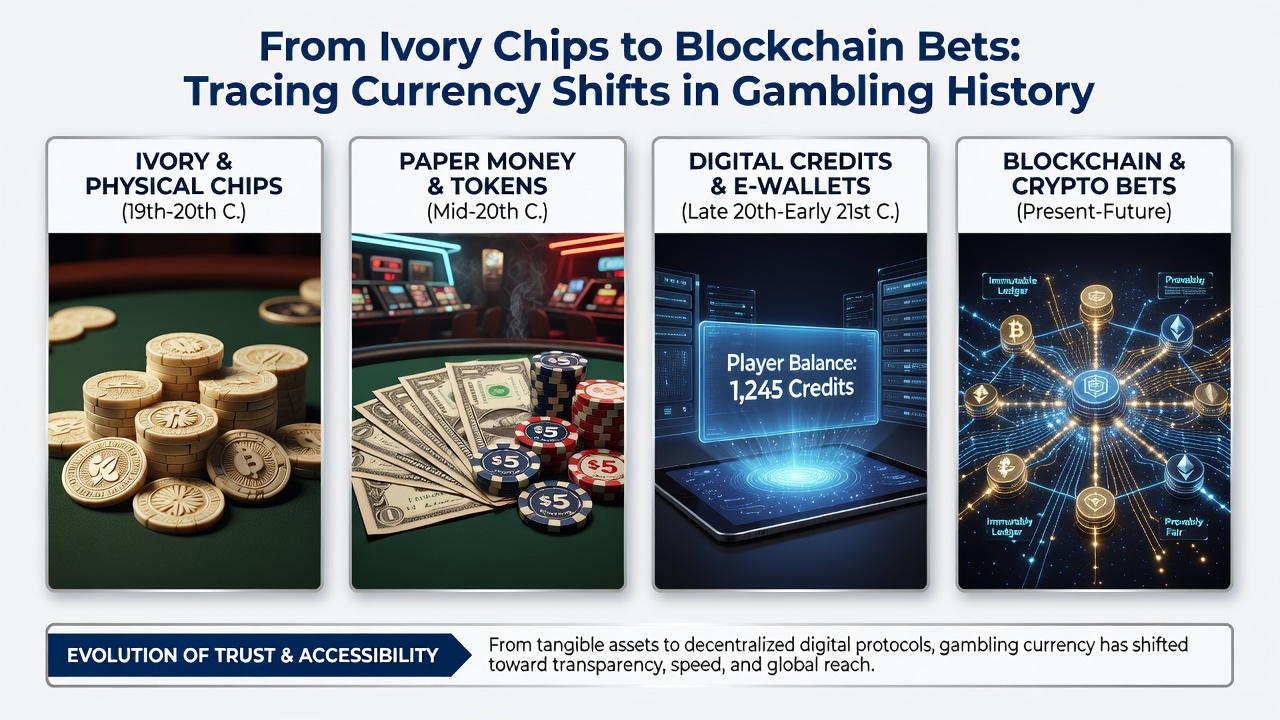
People have exchanged value through specialized tokens during gambling activities for centuries, and the evolution from physical objects like ivory chips to digital entries on distributed ledgers reflects broader economic and technological changes. Early societies relied on natural materials such as shells, bones, and carved ivory to represent wagers because these items held intrinsic worth and proved difficult to counterfeit at scale. Historical records from ancient China and Rome show that participants used standardized pieces of bone or stone during games of chance, which allowed bets to occur without constant handling of raw commodities like grain or livestock.
Transition to Standardized Casino Tokens
By the 19th century, American riverboat gamblers and European casino operators began producing uniform chips from ivory, clay, and later plastic composites to speed up play and reduce disputes over bet values. Nevada gaming authorities documented the shift toward state-approved chip sets in the 1930s, when regulatory oversight required casinos to maintain detailed inventories that prevented fraud through color-coding and serial numbering systems. These physical tokens functioned as a closed-loop currency inside individual establishments, redeemable only at the issuing property, which created a controlled environment where cash handling remained minimal during active sessions.
Observers note that the introduction of credit markers in mid-20th-century Las Vegas further detached gambling from immediate cash transactions. Patrons signed for advances against verified bank accounts or lines of credit, and this practice expanded as interstate banking regulations loosened in the 1980s. Data from the Nevada Gaming Control Board shows that marker play accounted for increasing percentages of table-game volume throughout the 1990s, illustrating how credit instruments began replacing physical currency even before widespread internet access.
Digital Currencies Emerge in Online Gambling
The arrival of internet-based casinos in the mid-1990s introduced electronic payment processors that accepted credit cards, wire transfers, and later e-wallets such as Neteller and PayPal. These systems converted traditional fiat balances into platform-specific credits that existed only as database entries, removing the need for physical exchange entirely. Researchers at the University of Nevada, Las Vegas tracked how transaction logs replaced chip trays, and settlement occurred through automated clearing houses rather than cage cashiers.
Yet regulatory fragmentation across jurisdictions created friction because many jurisdictions restricted cross-border transfers, forcing operators to adopt multiple payment rails simultaneously. Canadian provincial regulators, for example, permitted certain electronic funds transfers while Australian state authorities imposed stricter verification requirements on incoming deposits. Such differences prompted the gambling industry to explore alternative value transfer mechanisms that bypassed conventional banking networks.
Blockchain Integration and Cryptocurrency Adoption
Bitcoin's introduction in 2009 offered gambling platforms an immutable ledger for recording bets without relying on centralized financial intermediaries. Early adopters among offshore operators accepted the cryptocurrency because transactions settled faster than bank wires and carried lower fees for international players. By 2014 several poker networks had integrated Bitcoin deposits, and industry reports from the European Gaming and Betting Association documented rising volumes of crypto transactions among European users seeking privacy features inherent in public blockchains.
Smart-contract platforms that emerged later enabled provably fair games where random outcomes could be verified independently by participants. These systems encode game rules directly into code, so each spin or hand produces a cryptographic hash that anyone can audit after the fact. Figures from academic studies published in the Journal of Gambling Studies indicate that transparency claims associated with such protocols attracted technically inclined users who previously distrusted traditional random-number-generator claims.
Stablecoins pegged to fiat currencies further reduced volatility concerns that had previously limited crypto use in gambling. Operators began accepting USDT and USDC because these assets maintained relatively steady exchange rates against the dollar while still providing blockchain settlement speed. In July 2026 multiple European operators reported that stablecoin deposits comprised measurable shares of total incoming volume, reflecting gradual normalization of blockchain-based value transfer within licensed markets.
Regulatory Responses Across Regions
Government agencies responded at different paces. The Malta Gaming Authority established licensing categories that explicitly addressed cryptocurrency operators, requiring them to maintain segregated wallets and undergo regular audits of on-chain activity. Meanwhile Canadian provincial bodies such as the Alcohol and Gaming Commission of Ontario evaluated frameworks that would permit blockchain-based payment rails under existing financial-integrity rules. These varied approaches illustrate how currency innovation continues to intersect with compliance obligations that originally developed around physical cash and credit instruments.
Conclusion
The progression from ivory chips to blockchain entries demonstrates that gambling currencies adapt alongside available technology and regulatory environments. Each stage introduced new efficiencies while creating fresh oversight challenges that authorities addressed through updated licensing conditions and technical standards. Data collected by industry associations and academic researchers continues to track how distributed-ledger systems integrate with existing payment ecosystems, showing measurable but incremental shifts rather than abrupt replacement of prior methods.